
Engine Library / Aircraft Piston
Rolls-Royce Merlin
Twelve cylinders, a geared propeller and an evolving supercharger system.

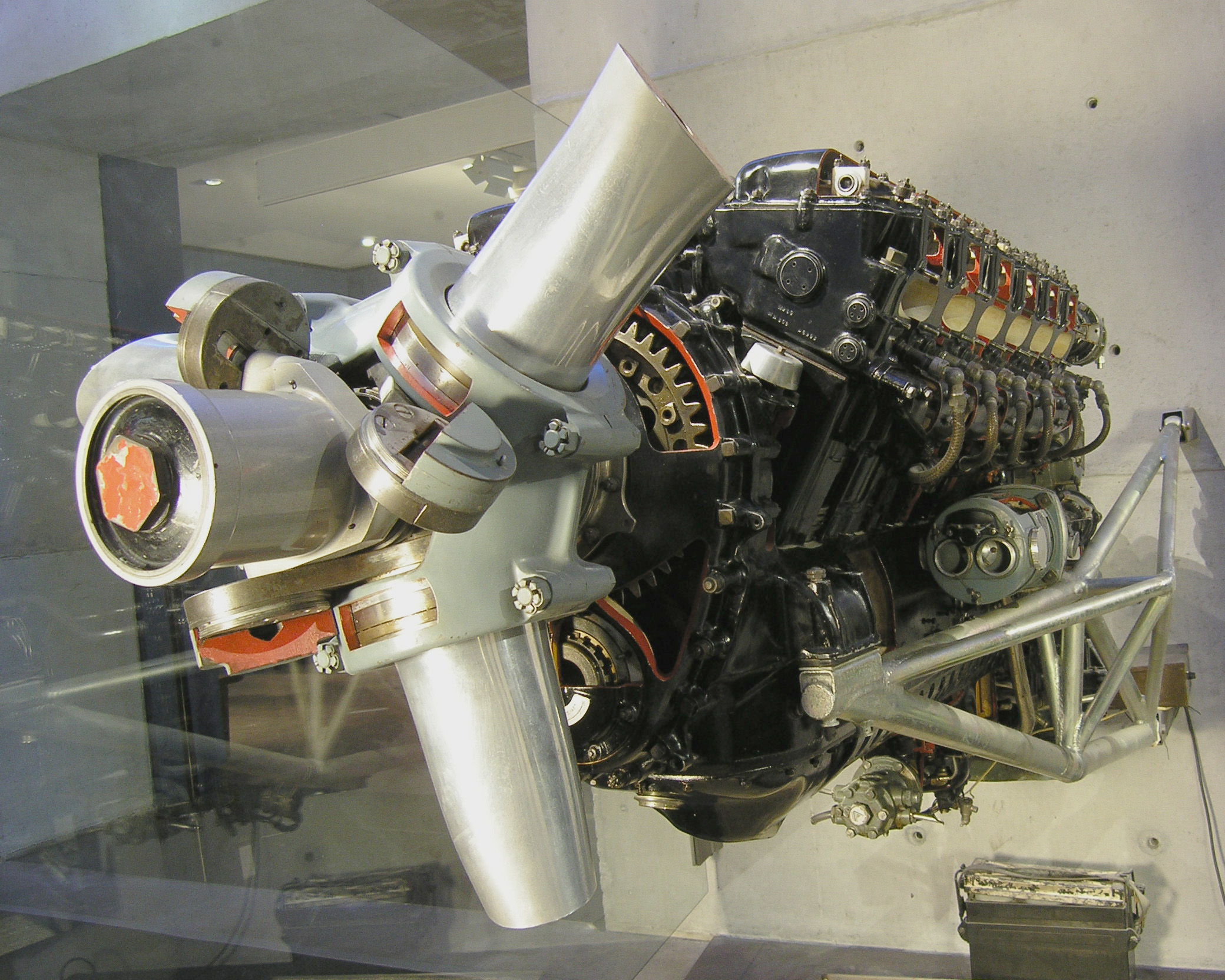
Rolls-Royce Merlin R.M. 14S.M. Mk 100 developmental prototype, built at Derby in June–July 1944; Smithsonian collection A19670085000.
Eric Long — Engine photograph. Source · CC0 1.0 Universal Public Domain Dedication · Original. Unmodified; resized for display.
.jpg)
At a Glance
- Layout
- Liquid-cooled 60-degree V12
- Cycle
- Four-stroke, spark ignition
- Displacement
- About 27 L / 1,649 cu in
- Air supply
- Mechanically driven supercharger; arrangement varies by mark
- Origins
- Experimental engine completed in 1933
- Familiar applications
- Hurricane, Spitfire, Mosquito, Lancaster and later Mustangs
Overview
A Merlin installation combines an engine with a system for supplying air, removing heat and driving a propeller. The twelve cylinders are only part of the explanation. Changes to the supercharger and its supporting equipment helped successive versions do useful work at different heights and in different aircraft.
Rolls-Royce developed the family in Britain. Packard subsequently manufactured licensed American derivatives under the V-1650 designation. A British Merlin mark and a Packard suffix identify particular developments; neither name supplies a universal horsepower figure. [heritage, usaf]
Historical Background
The experimental engine of 1933 began a development programme that continued through production. Testing led to revisions in the combustion chamber and cylinder construction. Drawing on experience with earlier engines such as the Kestrel, Rolls-Royce gradually turned the new design into a service powerplant. [banks]
Wartime demand made manufacture a major undertaking. Derby was joined by production at Crewe, Glasgow and Manchester, with licensed American manufacture adding further capacity. Science Museum Group describes production exceeding 150,000 engines; this is an attributed indication of scale, not a reconciled count of every maker and variant. Development engineer A. C. Lovesey also emphasized introducing improvements in steps that factories could absorb. [smg, lovesey]
Why It Was Developed
An aircraft designer needs power that can be carried into the air. Increasing engine output is useful only if its weight, size and supporting systems remain suitable for the aircraft. Rolls-Royce sought a more powerful twelve-cylinder engine within those constraints. [moorabbin]
Altitude posed a further problem: a cylinder taking in thinner air receives less oxygen. A supercharger raises intake pressure so the engine can receive a greater air charge. Fuel quality, cooling and component strength then limit how much of that extra charge can become useful power. This explains why Merlin development involved more than increasing cylinder size. [banks]
Where It Was Used
The same broad engine family served aircraft with very different demands: Hurricane and Spitfire fighters, the twin-engine Mosquito, and the four-engine Lancaster. Specific marks of other aircraft also used Merlins; an aircraft name alone does not establish its engine fit. [raf-collection]
Mustang history illustrates the importance of identification. Early Mustangs used Allison engines. Later Merlin-powered P-51 versions, including B/C and D/K aircraft, gained much better performance at high altitude. Postwar hydroplane racers also adopted Merlins, often with modifications that make them unsuitable references for standard aircraft ratings. [usaf, hydro-history]
How It Works
During intake, a piston admits a fuel-air charge; on compression it squeezes that charge with the valves closed. Spark ignition starts combustion, and pressure drives the piston outward on its power stroke. Exhaust completes the cycle. A connecting rod transmits piston force to an offset crankpin, turning the crankshaft. The cycle occupies two shaft revolutions, with the cylinders contributing successive power strokes.
The valve mechanism sits above the cylinders. One camshaft on each bank operates four valves per cylinder—two for intake and two for exhaust. These parts control the gas exchange rather than producing the engine's output themselves. [royce, period-data]
Gears take power from the engine to a centrifugal supercharger. Its rotating impeller accelerates the charge; the surrounding passages help turn that velocity into pressure. This is shaft-driven compression, unlike a turbocharger powered by exhaust. A separate reduction gearbox lets the propeller rotate more slowly than the crankshaft. [period-data, hydro-technical]
A stage is a compression step; a speed is a drive ratio. A single-stage supercharger can have two speeds. Later two-stage Merlins compress the charge in successive steps and use liquid-cooled charge cooling to manage the resulting heat. Those arrangements must be identified by version, rather than assigned to every Merlin. [period-data, lovesey]

Sectioned Merlin cylinders, pistons and valve gear at the Royal Air Force Museum Cosford.
Nimbus227 — Engine photograph. Source · Public-domain dedication by the copyright holder (PD-self), with unconditional any-purpose fallback. Unmodified; resized for display.


Key Mechanical Features
- Two cylinder banks: six cylinders per bank share the crankshaft in a 60-degree V arrangement. [banks]
- Overhead cams and four valves: gas flow is controlled in the heads, with no automotive-style cam-in-block pushrod chain. [royce]
- Liquid cooling: coolant transfers engine heat to radiators outside the engine. [hydro-technical]
- Dual ignition and dry-sump lubrication: two plugs serve each cylinder; scavenging removes oil from the engine to a separate supply system. [hydro-technical]
- Version-specific fuel control: later pressure carburettors and metering arrangements differ from early float systems. Fuel delivered at a supercharger inlet is not direct injection into the cylinders. [shilling, lovesey]
The Auckland Museum’s sectioned Merlin F demonstration engine, with the propeller hub and reduction gearing exposed.
Auckland Museum (institutional photograph; individual photographer not credited) — Engine photograph. Source · Creative Commons Attribution 4.0 International (CC BY 4.0) · Original. Unmodified; resized for display.
.jpg)
Typical Specifications
The Smithsonian's Packard-built V-1650-3 provides a defined example. It is not the developmental Mk100 pictured above. [smithsonian]
| Item | Catalogued V-1650-3 |
|---|---|
| Arrangement | Supercharged, liquid-cooled V12 |
| Displacement | 27 L / 1,649 cu in |
| Bore × stroke | 137 × 152 mm / 5.4 × 6 in, rounded |
| Listed power | 1,380 hp / 1,029 kW at 3,000 rpm |
| Listed mass | 766.6 kg / 1,690 lb |
The catalogue does not give altitude, boost, fuel grade or permitted duration for that power figure, nor a weighing condition for the mass. Takeoff, combat and continuous ratings describe different duties. They cannot be combined into one family-wide rating. [smithsonian, period-data]
Advantages and Limitations
The V12 package offered substantial power for its weight and room for further development. Repeated changes to air supply, materials and cooling improved what the family could deliver. Its success depended on that continuing work. [smg, banks]
Supercharging also consumes engine power, and liquid cooling requires radiators, pumps and pipework. Early float-carburettor fuel delivery could be disrupted by negative acceleration. Beatrice Shilling's restrictor reduced flooding; subsequent fuel-control changes went further. Neither the restrictor nor inlet metering should be described as direct cylinder injection. [hydro-technical, shilling, lovesey]
Why It Was Replaced or Discontinued
Moorabbin Air Museum places the production endpoint around 1950. That approximate date does not establish every factory's closure schedule or the end of service. [moorabbin]
Larger piston engines addressed some later requirements, while turbine propulsion opened different possibilities for new aircraft. Rolls-Royce pursued jets during wartime Merlin manufacture. The change in new-aircraft choices was gradual and reflected the whole aircraft's mission, rather than a single defect shared by every Merlin. [heritage]
Modern Use and Surviving Examples
Preservation lets visitors study both exterior installations and exposed internals. Science Museum Group's Merlin 45, made at Crewe around 1941, was sectioned and equipped with an electric drive for instruction. A teaching display is not evidence of airworthiness. [smg]
Operator reports provide narrower evidence of actual flying. The RAF reported Spitfire AB910's post-overhaul flight on 28 January 2026. A separate February 2026 report described Lancaster PA474 undergoing major maintenance at Duxford. These are dated events, not promises of present availability. [ab910, pa474]
Notable Variants and Related Engines
- Merlin XX: single-stage supercharging with two drive speeds. [period-data]
- Merlin 45: closely associated with the Spitfire V. [smg]
- Merlin 61: two-stage, two-speed supercharging with charge cooling. [period-data]
- Packard V-1650: licensed American derivatives with their own suffixes and applications. [usaf]
- Griffon: a separate, larger Rolls-Royce design, about 36.7 litres. [banks]
- Meteor: a Merlin-derived engine adapted for tanks. [meteor]
The Pratt & Whitney Double Wasp offers a useful comparison: a two-row air-cooled radial solving aircraft-power problems with a very different cylinder arrangement.
Image Gallery
The photographs show a later developmental engine, unidentified-mark cylinder cutaway, early instructional Merlin F and preserved Mosquito installation. Each caption identifies its limits. They are not interchangeable illustrations of one engine version.

Exposed Merlin installation in a preserved de Havilland Mosquito at RAF Museum Cosford. The photographer identifies a Merlin 114 and a TT35 restored to represent a B35.
Hugh Llewelyn — Engine photograph. Source · Creative Commons Attribution-ShareAlike 2.0 Generic (CC BY-SA 2.0) · Original. Unmodified; resized for display.
.jpg)
Sources and Further Reading
Manufacturer histories establish context; period technical accounts explain development; collection and operator records identify particular engines and events. Dora's source register was checked on 2 October 2026. Historical documents are evidence for this explanation, not current operating instructions.