
Engine Library / Aircraft Piston
Pratt & Whitney R-2800 Double Wasp
Two rows of cylinders turn combustion into aircraft power.

Pratt & Whitney R-2800 displayed at Hermeskeil, identified by the photographer as an R-2800-CB17. The two cylinder rows and propeller reduction housing are visible.
Alf van Beem — Pratt & Whitney R-2800-CB17 engine used in DC-6 and Convair 440, pic2.jpg. Source · CC0 1.0 Universal. Unmodified; resized for display.

At a Glance
- Layout
- Fixed radial; two rows of nine cylinders
- Cycle
- Four-stroke gasoline, spark ignition
- Cooling
- Air cooling through finned cylinders
- Displacement
- About 46 L; designation rounded to 2,800 cu in
- Production
- 1939–1960, according to Pratt & Whitney
- Familiar applications
- Thunderbolt, Hellcat, Corsair and DC-6
Overview
Look at a Double Wasp from the propeller end and the cylinders form a circle. Look along its side and a second row becomes apparent. Eighteen cylinders supply a single shaft, giving aircraft designers a large displacement in a comparatively short engine. [S1]
The cylinders stay fixed to the aircraft while the crankshaft turns. That makes this a radial, unlike early rotary aircraft engines whose cylinder assembly spun around a stationary shaft. Circular appearance does not establish the operating principle. [S5]
Historical Background
Pratt & Whitney developed the engine in the late 1930s and showed it publicly at New York's 1939 World's Fair. Wartime requirements expanded production, but the design also continued into commercial aviation. The manufacturer's retrospective gives 1939–1960 and more than 125,000 engines, including licensed manufacture. [S1, S3]
Ford participated in that manufacturing effort: the USAF museum preserves an R-2800-21 built at Dearborn in 1943. Engineering work continued alongside output. Archival accounts of the crankshaft describe extensive investigation of vibration, counterweights and absorbers. The production engine was the result of repeated development. [S4, S6]
Why It Was Developed
New aircraft asked for more power without an engine of proportionately greater diameter. A second cylinder row added displacement behind the first. That choice brought a problem with it: rear cylinders needed an adequate share of cooling air. [S8, S6]
Powerplant and airframe had to be developed together. The Navy's high-speed fighter requirement helped shape the Double Wasp-powered Corsair; clearance for its large propeller contributed to the inverted gull wing. Cooling-fin and valve-timing investigations likewise show that useful power depended on more than fitting additional pistons. [S7, S8]
Where It Was Used
Thunderbolt, Hellcat and Corsair fighters are familiar applications, but the engine also served multi-engine aircraft such as B-26 Marauder variants and the Curtiss C-46. Aircraft versions require their own engine identifications. [S1]
The civil CB16 carried the design into airline service in DC-6A/B aircraft, Martin 202A/404 aircraft and the Convair 340. An engine family could therefore outlast its original wartime role without every installation sharing the same hardware. [S2]
How It Works
Each cylinder completes intake, compression, power and exhaust over two crankshaft turns. A spark starts combustion in the compressed charge. Pressure moves the piston, and the connecting-rod system applies that force to the crankshaft. Successive cylinders contribute power at different times. [S9]
Each nine-cylinder row has a master rod and eight articulated rods. The master rod connects to the crankpin; the other rods pivot on pins around its large end. A two-throw crankshaft serves the two rows. This gathers many piston forces without the long crankshaft of an eighteen-cylinder inline arrangement. [S6, S9]
The rear row is staggered behind gaps in the front row. Fins provide cooling surface, while baffles and cowling direct air through the assembly. These parts form a cooling system even though there is no liquid-coolant radiator. [S6, S1, S10]
An engine-driven centrifugal supercharger raises intake pressure. Its stages and drive speeds vary by version: the civil CB16 has one stage and two speeds. The P-47's installation additionally used a remote exhaust-driven turbo-supercharger in the fuselage, with intercoolers and ducts. The engine's internal supercharger and that separate aircraft equipment must not be confused. [S2, S10]

A museum cutaway identified as an R-2800-71 at JASDF Miho Air Base. The opened rear-side assembly exposes gears, the centrifugal supercharger impeller and part of the crank train.
Hunini — Pratt & Whitney R-2800-71 engine cutaway model at Archive room of JASDF Miho Air Base May 28, 2017 02.jpg. Source · CC BY-SA 4.0 International. Unmodified; resized for display.

Key Mechanical Features
- Cam rings: multi-lobed, geared rings distribute valve timing around each cylinder row. Followers, pushrods and rockers open one inlet and one exhaust valve per cylinder; springs close them. [S9, S8]
- Cooling fins and baffles: surface area and directed flow work together to remove heat. [S1, S10]
- Two plugs per cylinder: ignition arrangements vary. A dual system does not necessarily have two separate external magneto housings. [S11, S12]
- Reduction gearing: the propeller runs more slowly than the crankshaft; the ratio belongs to the named variant. [S9, S11]
- Vibration control: counterweights and absorbers address loads from combustion and moving masses. [S6]

Cylinder detail on the Miho R-2800-71 cutaway shows the piston, rings and part of the overhead-valve mechanism within the finned cylinder assembly.
Hunini — Pratt & Whitney R-2800-71 engine cutaway model at Archive room of JASDF Miho Air Base May 28, 2017 13.jpg. Source · CC BY-SA 4.0 International. Unmodified; resized for display.

Typical Specifications
This table describes the CB16, using Federal Aviation Agency specification E-264, revision 9, dated 6 June 1962. The hero photograph is identified as CB17. [S11]
| Item | CB16 example |
|---|---|
| Cylinders | 18, air-cooled radial |
| Bore × stroke | 5.75 × 6.00 in |
| Displacement | 2,804 cu in / about 46 L |
| Compression ratio | 6.75:1 |
| Dry weight | 2,400 lb |
| Propeller/crankshaft ratio | 0.45:1 |
| Selected takeoff rating | 2,400 hp at 2,800 rpm; sea level; five minutes |
That rating requires low blower, anti-detonant injection, 59.5 inHg manifold pressure and at least 100/130 aviation gasoline. Omitting these conditions would misrepresent the figure. It is neither continuous output nor a specification for the whole R-2800 family. [S11]
Advantages and Limitations
Two radial rows offered many cylinders and a short crankshaft. Air cooling removed the liquid-coolant circuit, but it demanded careful control of air through the engine. The complete installation could still be large: the P-47's distant turbo needed substantial ducts. [S9, S10]
Heat and vibration constrained increased output. NACA tests compared cooling fins and valve timing, finding tradeoffs between operating conditions. Some ratings also depended on anti-detonant fluid injection to permit higher boost for limited periods. That additional equipment controlled abnormal combustion; it did not replace basic cylinder cooling. [S8, S6, S12]
Why It Was Replaced or Discontinued
Pratt & Whitney gives 1960 as the end of new production. Aircraft already in service did not all stop flying then. [S3]
Jets and turboprops changed new-aircraft choices as airlines sought different combinations of speed and operating capability. A turboprop retained a propeller but used a gas turbine in place of the reciprocating engine. Adoption proceeded by mission and operator, leaving useful work for existing piston aircraft. [S13]
Modern Use and Surviving Examples
Collections preserve different versions and teaching cutaways. The Ford-built USAF specimen and Smithsonian CB16 record document specific objects; the latter was listed as not on display in Dora's 2 October 2026 check. Museum ownership does not establish running condition. [S4, S2]
Operator evidence is more specific. The Flying Bulls identifies R-2800 power in its DC-6B and documented a summer 2026 U.S. tour. Everts Air's fleet page, checked on 2 October 2026, listed DC-6 aircraft with CB17 engines. These dated records support those examples, not a blanket claim about every surviving engine's airworthiness. [S14, S15, S16]
Notable Variants and Related Engines
- R-2800-21: the 1942 P-47B handbook gives sea-level takeoff output of 2,000 hp at 2,700 rpm, five minutes, with 100-octane gasoline. Its aircraft installation includes the remote turbo. [S10]
- CB16: the identified civil version in the specification table. [S11]
- CB17: another civil development, identified in the Everts fleet record and hero-image source. [S16]
- R-1830 Twin Wasp: fourteen cylinders in two rows. [S17]
- R-4360 Wasp Major: twenty-eight cylinders in four rows. [S18]
The liquid-cooled Rolls-Royce Merlin provides a contrasting aircraft-engine layout. These related names identify different engines, not interchangeable Double Wasp specifications.
Image Gallery
The selected views cover the overall radial arrangement, engine-driven supercharger, cylinder mechanism, accessory layout and a preserved Corsair. The Miho cutaways are identified as R-2800-71; they do not depict the P-47's remote turbo.
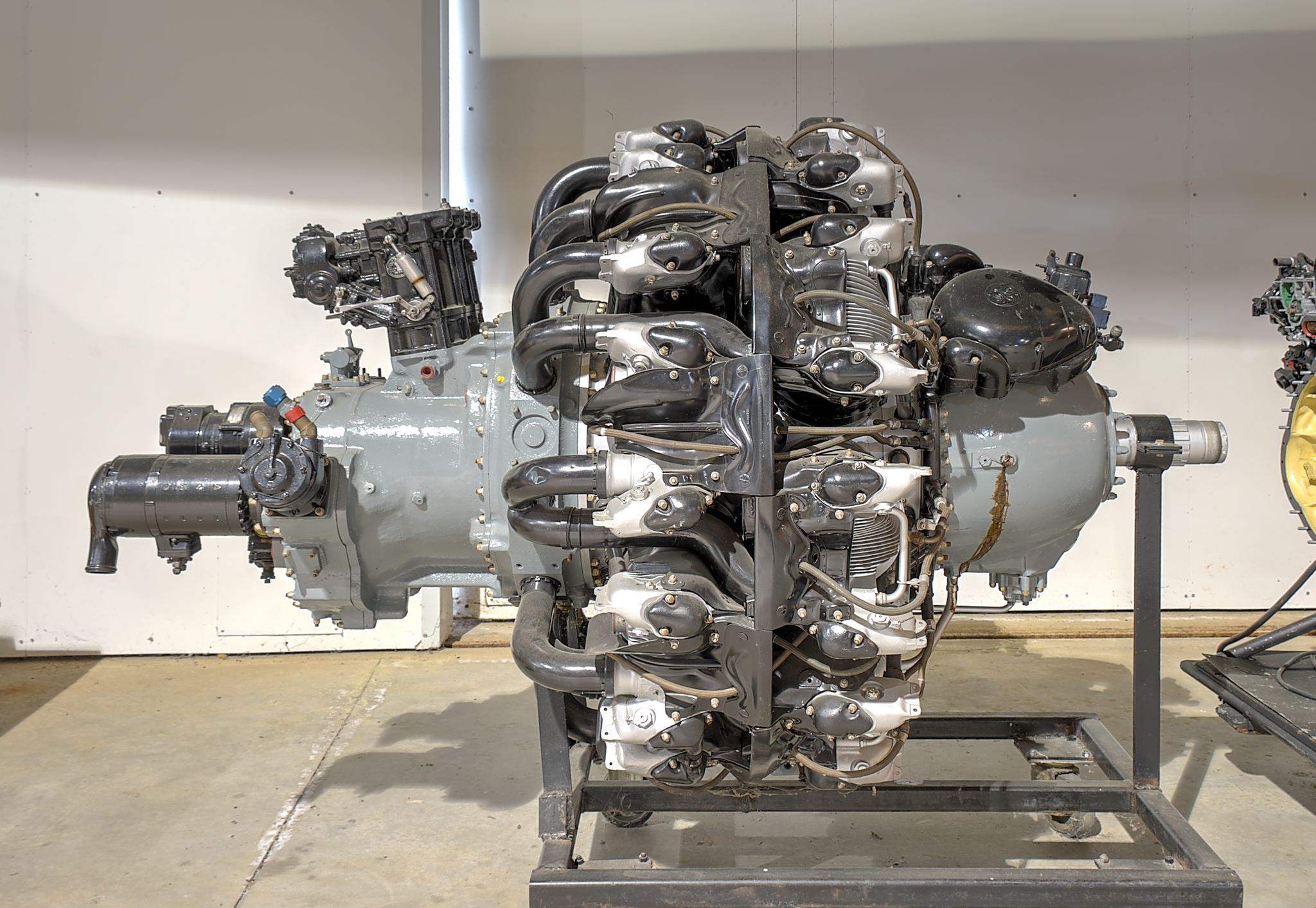
Side profile of a preserved R-2800 Double Wasp at the Museum of Aviation, Warner Robins. The front reduction housing is at right; the rear accessory section extends to the left.
Dsdugan — 20-09-083-R 2800.jpg. Source · CC0 1.0 Universal. Unmodified; resized for display.


A preserved Vought F4U-1D Corsair at the Steven F. Udvar-Hazy Center, photographed in 2025. The Corsair was a major R-2800 application.
Acroterion — F4U-1D Corsair at the Steven F. Udvar-Hazy Museum VA1.jpg. Source · CC BY-SA 4.0 International. Unmodified; resized for display.

Sources and Further Reading
The museum records introduce the family. The period P-47 handbook and civil CB specification show how installation and rating conditions change the interpretation of a number. NACA and crankshaft studies explain development decisions. Dora's source register records access on 2 October 2026; these historical documents are not current flight or maintenance instructions.
- S1. National Air and Space Museum, Engine, Pratt & Whitney Double Wasp R-2800-43, 2-Row, Radial 18, A19660391000
- S2. National Air and Space Museum, Pratt & Whitney Double Wasp R-2800 CB16, 2-Row, Radial 18 Engine, A19580058000
- S3. Pratt & Whitney, In 1963, Dependable Engines Answered a Nation's Call of Mourning, 2013-11-22
- S4. National Museum of the United States Air Force, Pratt & Whitney R-2800
- S5. National Air and Space Museum, Sweet Moments in a Sopwith
- S6. Aircraft Engine Historical Society; Kimble D. McCutcheon, No Short Days: The Struggle to Develop the R-2800 “Double Wasp” Crankshaft
- S7. Naval History and Heritage Command / National Naval Aviation Museum, Tool of the Trade
- S8. NACA; David S. Boman and Samuel J. Kaufman, Effect of Reducing Valve Overlap on Engine and Compound-Power-Plant Performance, TN 1612, June 1948
- S9. Federal Aviation Administration, Aviation Maintenance Technician Handbook—Powerplant, FAA-H-8083-32B, chapter 1
- S10. US Government, Preliminary Handbook of Operation and Flight Instructions for the Model P-47B Pursuit Airplane, T.O. 01-65BC-1, 1942-04-25
- S11. Federal Aviation Agency, Aircraft Engine Specification E-264-9, Pratt & Whitney Double Wasp CB3, CB16, CB17, CB4, 1962-06-06; reformatted 12/1993
- S13. National Air and Space Museum, The Evolution of the Commercial Airliner
- S14. The Flying Bulls, Kraftpaket mit Geschichte [A powerhouse with pedigree]
- S15. The Flying Bulls, Welcome back! Two aviation legends and their journey across the Atlantic
- S16. Everts Air, McDonnell Douglas DC-6
- S17. National Air and Space Museum, Pratt & Whitney Twin Wasp R-1830-90C (R-1830-S3C4-G), 2-Row, Radial 14 Engine, A19600115000
- S18. National Air and Space Museum, Pratt & Whitney Wasp Major R-4360-4A, Radial 28 Engine, A19840656000