
Engine Library / Gasoline / Piston
Ford Flathead V8
The valves sit beside the pistons. That simple relationship shaped Ford’s affordable V8—and its engineering tradeoffs.
Introduced in 1932, the flathead brought eight-cylinder power to Ford’s low-price cars and became a lasting part of hot-rod culture.

Teaching cutaway photographed at the LeMay Family Collection in 2015. The exact engine variant and year are not established.
Ford Flathead Cutaway — JOHN LLOYD. Source · CC BY 2.0 · Original. Unmodified; resized for display.
.jpg)
At a Glance
- Layout
- Eight cylinders in two banks; four-stroke gasoline engine
- Valve arrangement
- Side valves in the block, beneath detachable heads
- Cooling
- Liquid cooling
- Introduced
- 1932
- Main U.S. Ford era
- 1932–1953; overseas derivatives require separate dates
- Today
- Historic vehicles, preservation and hot-rod projects
Overview
Look at a flathead with its cylinder head removed and the name begins to make sense: the valves are next to the pistons. The head closes the combustion space above them but carries no overhead valve mechanism. That arrangement gives the Ford V8 a different character from the pushrod and overhead-cam engines that followed. [S7]
Ford introduced this engine in 1932. V8s already existed; Ford's contribution was making one practical for its low-price, high-volume cars. The engine's later role in hot rodding grew from that large population of production machinery. [S1, S2, S3]
Historical Background
The difficult part of building an affordable V8 was more than adding cylinders. Ford wanted both banks and the crankcase to emerge from the foundry as one main casting. The cylinder heads were still separate, removable parts. Turning that idea into repeatable factory work was a central engineering challenge. [S1, S3]
Henry Ford assigned a small team to the project at Greenfield Village while Chevrolet's six-cylinder cars competed for ordinary buyers. The resulting 1932 engine began a long development history. Later flatheads changed in detail and output; the family name does not make an early engine and a postwar example identical. [S2, S3, S4]
Why It Was Developed
Ford needed a powerplant it could sell in large numbers at an accessible price. A V8 offered buyers eight-cylinder performance, but that attraction depended on an economical manufacturing method. Combining the crankcase and cylinder banks in a casting reduced the need to assemble those major structures separately. The foundry work and the sales objective therefore belonged to the same problem. [S1, S2]
Where It Was Used
Cars and trucks were its principal setting, but documented service extended beyond civilian roads. Museums Victoria identifies side-valve Ford V8s in Canadian Military Pattern trucks and Australian LP2/LP2A carriers. Its Canadian-built surviving engine later drove a mobile crane at a Melbourne dry dock—one specific example of a vehicle engine finding another job. [S5]
Custom builders gave the family a further life in hot rods. Collections also preserve specialized uses such as V8-60 marine engines. A racing or marine installation should be identified on its own terms, rather than treated as the original Ford road-car configuration. [S3, S9]
How It Works
Two processes run together: combustion produces the turning force, and the camshaft schedules the valves so each cylinder can breathe.
Inside a cylinder, the piston repeats four strokes. It draws in a fuel-air mixture through the inlet valve, compresses that mixture with both valves shut, is driven downward by combustion after spark ignition, and then pushes burned gas out through the exhaust valve. These strokes occupy two turns of the crankshaft. The eight cylinders perform their power strokes in succession, rather than all at once. Actual ignition and valve events extend around the stroke boundaries; this is a simplified description of the cycle. [S8, S11]
The piston cannot turn the shaft directly. Its connecting rod transfers force to a crankpin offset from the shaft's centre. As the piston travels along the bore, the rod changes angle and the crankshaft rotates.
Valve motion follows a shorter chain: cam → tappet → valve. A cam raises a tappet beneath the valve stem; a spring seats the valve again as the cam turns away. The camshaft rotates once for every two crankshaft revolutions. In this standard side-valve layout, no pushrod and rocker assembly reaches up into the head. [S7, S11]
The gas path is less direct than that short mechanical chain. The head's combustion space connects the cylinder bore with the valves beside it. Incoming mixture crosses that space to reach the cylinder; exhaust leaves through the adjacent valve. Seeing both paths explains what a flathead simplifies and what it asks the gases to do. [S7]
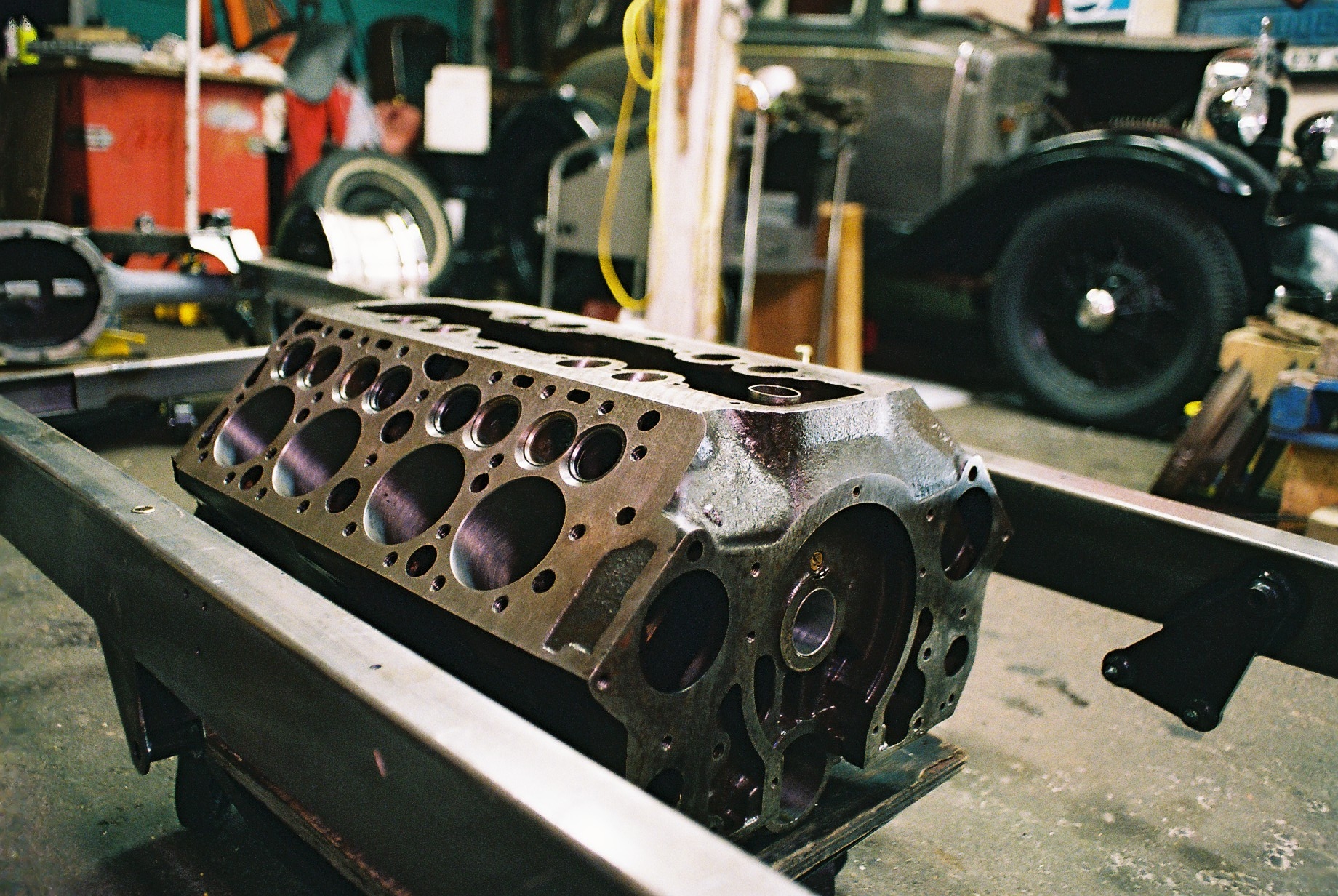
Head removed from a Ford flathead block: valves sit beside the cylinder bores. This is a disassembled block, not a cutaway.
The Valve In Block Design or Flathead Block — Moefuzz. Source · CC BY 3.0. Unmodified; resized for display.

Key Mechanical Features
- One main block casting: the crankcase and both cylinder banks form the core structure; detachable heads close it above. [S1]
- Valves alongside the bores: their position, rather than the outside shape of a polished head, defines the side-valve arrangement. [S7]
- Cam and tappets below: valve operation stays within the block instead of extending into overhead rocker gear. [S7]
- Exhaust routed through the block: hot passages run between cylinders before reaching the exterior, adding to the cooling and casting demands. [S6]
On a complete engine, the two broad heads and central intake are useful visual clues. Modified examples may carry replacement heads, manifolds and accessories; those parts are not evidence of a standard factory specification.

Customized Ford flathead installation at the Essen Motor Show, photographed in 2005. Its visible equipment should not be treated as factory-stock 1932 hardware.
Ford Flathead V8 — Thomas Vogt. Source · CC BY 2.0 · Original. Unmodified; resized for display.
.jpg)
Typical Specifications
These two documented Ford examples show why a year matters when quoting a flathead's output. Neither column describes the entire family.
| Specification | 1932 Ford V8 | 1949 Ford passenger-car V8 |
|---|---|---|
| Valve layout | L-head / side-valve | L-head / side-valve |
| Displacement | 221 cu in / about 3.62 L | 239 cu in / about 3.92 L |
| Published power | 65 hp at 3,400 rpm | 100 hp at 3,600 rpm |
| Recorded example | The Henry Ford's engine No. 1 | The Henry Ford's V8 Club Coupe |
The early rating is also corroborated by Museums Victoria. Litres are rounded conversions. These historical horsepower figures should not be compared directly with modern net ratings without knowing the test conditions. No bare-engine weight is given: vehicle weights and museum display measurements would not supply that missing fact. [S1, S4, S5]
Advantages and Limitations
The layout places the valve mechanism close to the camshaft and leaves the heads free of overhead operating gear. Coupled with volume manufacture, that helped deliver Ford's affordable V8 objective. Its lasting enthusiast following also reflects the availability of engines and modification parts. [S1, S3, S7]
There was a tradeoff inside the combustion space. A side valve needs room for gas to travel between the valve and cylinder, while a higher compression ratio calls for a smaller chamber. Those aims can compete. This is an engineering explanation of the geometry, not a diagnosis that every flathead overheats or is unreliable. The internal exhaust route also places heat within a block that already has demanding passages to cast and cool. [S6, S7]
Why It Was Replaced / Discontinued
For the 1954 U.S. passenger-car range, Ford moved to its overhead-valve Y-block. Ford's account connects the new design with higher-compression potential, improved airflow, structural rigidity and manufacturing considerations. It required a new architecture; fitting different heads alone did not turn the side-valve engine into its successor. [S6]
The familiar 1953 endpoint applies to the U.S. Ford chapter. It is not a verified final date for every Canadian, European or other related flathead derivative.
Modern Use and Surviving Examples
Today the flathead can be encountered as a preserved object, an engine in a historic car, or a modified enthusiast project. These contexts answer different questions: a cutaway reveals construction, while an installed engine shows how accessories and the vehicle surround it.
The Henry Ford holds engine No. 1 and V8-powered vehicles. The Early Ford V-8 Foundation Museum's collection includes cutaways and V8-60 examples, and the Early Ford V-8 Club of America supports preservation activity. Museums Victoria's Canadian-built engine was recorded as in storage in Dora's 2 October 2026 research. Collection ownership does not guarantee current display or running condition. [S1, S4, S5, S9, S10]
Images
The selected photographs distinguish a teaching cutaway, a disassembled block, a preserved vehicle, a catalogued engine and a customized installation. They document those particular objects; they do not all depict the 1932 specification.

1932 Ford Model 18 Standard Tudor Sedan, photographed in 2007. A modern photograph of a historic car.
1932-Ford-V8.jpg — IFCAR. Source · Worldwide public-domain release (not CC0). Unmodified; resized for display.


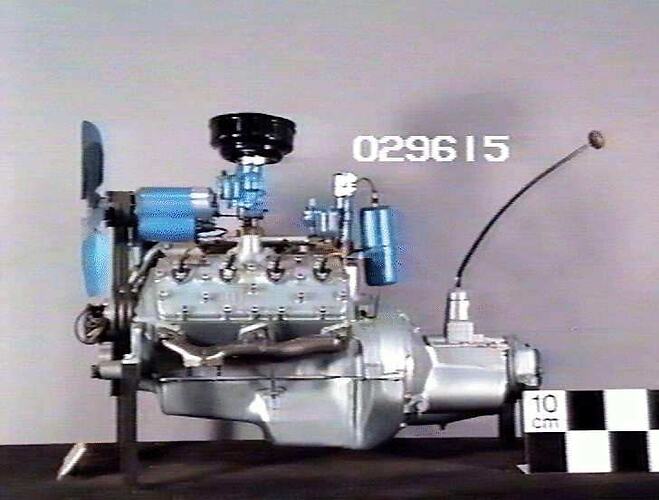
Museums Victoria ST 29615: Canadian-built truck-type V8 and gearbox, catalogued circa 1932 and later refurbished. Shown as a small inset.
Engine — © Museums Victoria. Source · CC BY 4.0. Unmodified; resized for display.
Sources and Further Reading
Begin with the collection records for the two dated engines, then compare the valve geometry in Ford's patent with the general four-stroke and camshaft explanations. Sources were checked in Dora's research on 2 October 2026. This article explains historical machinery; it is not a service or tuning manual.
- S1. The Henry Ford: 1932 Ford V-8 Engine, No. 1
- S2. The Henry Ford: The Ford V-8 curated collection
- S3. The Henry Ford: Ford's Game-Changing V-8 Engine
- S4. The Henry Ford: 1949 Ford V-8 Club Coupe
- S5. Museums Victoria: Ford side-valve V8, ST 29615
- S6. Ford Racing: The Whys and Wisdom of Ford's Venerable Y-Block
- S7. Henry Ford: U.S. patent 1,975,837
- S8. NASA Glenn: Internal Combustion Engine Stages
- S9. Early Ford V-8 Foundation Museum: collection gallery
- S10. Early Ford V-8 Club of America
- S11. FAA: Powerplant Handbook, AC 65-12A